Showing posts with label pastel. Show all posts

Sunday, September 7, 2014

Sierra Painting Pack Trip 2014

A group of 8 artists, Paul Kratter, Terry Miura, Ernesto Nemesio, Michelle De Bragança, Robert Steele, Lori Putnam, and myself, hiked and rode up to (drunken) Sailor Lake in the Sabrina basin in late August. It was a bit of a long grind going up. But, no one was hung over, nor was it raining, so much better than some other years. I am not in great shape though, and the higher elevation of this spot really had an effect. At 11,000', I could only plod very slowly on any incline. If I went any quicker, I simply could not breathe and keep moving. Its pretty humbling. One lesson I learned years ago on these hikes was that I usually could not enjoy much of the view while moving, as I needed to constantly pay attention to where my feet were, to avoid falling on my face, so stopping in order to breathe was a great way to appreciate the scenery as we climbed out of the lake basin. We hiked around towards the back side of Sabrina, roughly level, among many small aspens, and then began to ascend, via switchbacks, and some long, steep inclines over talus slopes, crossing several watercourses along the way. 


The hikers at the Sabrina trailhead. L-R: Lori Putnam, Michelle De Bragança, Ernesto Nemesio, and Terry Miura.

After a few hours of huffing and puffing the point of view begins to change. Those are the Piute Crag  looming behind the Lake Sabrina basin. Less than halfway there, but progress!


About 3 miles in, after surmounting the back wall of the basin, we arrived at Blue Lake, which looked good enough to make us wonder why we needed to go any further, yet we were only half way to our destination. We stopped for lunch and a rest, then continued our upward journey through fox tail pines, amid a landscape dotted with huge erratic boulders, granite benches, walls, and numerous small ponds. We often found ourselves hiking over acres of solid granite, with the trail being marked by stones on either side.

At Blue Lake (actually shot on the hike out). Pretty nice scenery and water here.


The mules had passed us at Blue Lake, so the 5 of us that elected to hike in, were strung out somewhere behind them. I straggled into camp in the late afternoon, met the cook, Ally, and her grandfather, Jerome, who was helping her out. They had a full on cook tent, that looked like a small house, with a metal frame, heavy canvas walls, and a large supply of propane tanks for cooking and heating. I grabbed my gear from the tarp, set up my tent, and started to survey the landscape possibilities.

The view from camp towards Picture Peak. Mt. Haekel on the right, and Clyde Spires over the left shoulder. The cook 'house' to the right of Terry Miura.


 We were camped on the shores of Sailor Lake, which was, in my mind, more of a very shallow, meandering pond, in a descending glacial basin. About a quarter mile 'up' the basin to the west, was Hungry Packer Lake, out of sight over the U shaped ground plane that ended visually in the rocky slopes of Picture Peak, a ragged pyramid that dominated the skyline in that direction. To our left, was a small waterfall, fed from the outlet to Moonlight Lake, which could be reached by a short scramble. A curving wall of cracked granite flanked our north, dotted with small trees, over which some larger crags were visible. If we looked roughly east, down the basin, towards the desert floor, we could see the White Mountains glimmering faintly miles away, while the sloping foreground was a series of ponds, stands of pines, and boulders, which ended in Topsy Turvy Lake. The rest of our horizon was ringed with jagged escarpments and shattered rock slopes, well above the tree line.


A study looking down the basin in morning light. 6 x 9", pastel on paper.

Here's a wider view, looking the same direction, painted on the last morning of the trip.
9 x 9.5", pastel on paper.

Morning Icon worship


Charles Muench, who painted at this spot last year, had advised Paul and I that he felt the scenery was dominated by this singular view of Picture Peak. As a result, I deliberately avoided painting this view all week, though I did paint parts of the mountain.  Others, however, went at the peak every morning from sunrise on. It was very convenient to paint from camp in the morning, as we were served hot coffee at our easels by Jerome. Quite a luxury in such a location. 


North of Morning Coffee, 6 x 9, pastel on paper

The Wall to the West, 9 x 9.5, pastel on paper
Here's an example of painting just a part of Picture Peak, emphasizing atmosphere and scale relationships. Not painting the 'thing' or the object, but elements or aspects that can make for an interesting painting.


The first lake outside of camp that we visited was Moonlight lake, which was a 10 minute scramble to the south. It was big, deep, and unusually turquoise. Ernesto and I painted there one cloudy afternoon, then returned one sunny morning with everyone for a delightful day of painting, and even a little swimming, though it was too cold to stay in very long. 


Sun Spot, 9 x 9.5, pastel on paper
My first painting from Moonlight Lake. The clouds built up pretty quick, but small spots of light would would periodically glow and drift amongst the peaks. This is a view of Clyde Spires, which is visible in the photo above, to the left of Picture Peak. I usually don't do very wide views, and this is a good example of how a small section of a scene will suit me.
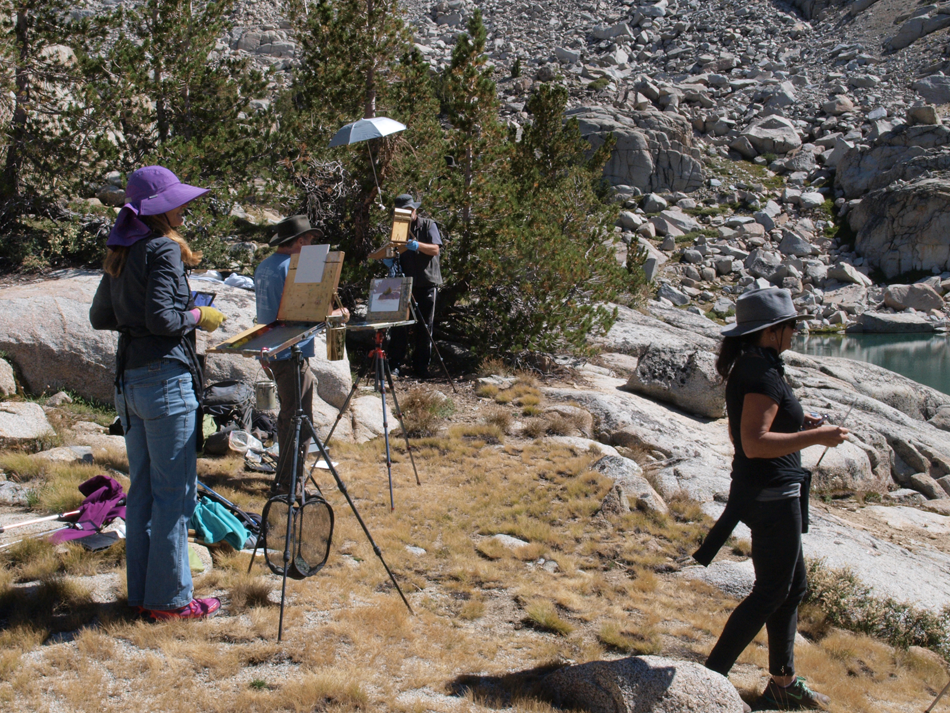
A great day at Moonlight Lake. We are often on our own, so it is rare, and fun when everyone is in the mood to paint at the same spot. 

Moonlit Shore, 9 x 9.5, pastel on paper
The south shore of the lake nearest us was full of boulders and cliffs that ran down into the turquoise water. I picked a small section of that to paint. 

Cloud Study, 6 x 9, pastel on paper

We had several consecutive days of cloud build up that threatened a big downpour, yet we never had rain, just masses of cumulus looming over the peaks to the west, then dissipating towards the desert to the east. The edge of this mass would swell and retreat for hours, constantly shifting in form and color.

In the evening the clouds would create enormous variations of light and shadow patterns on the peaks, from ridiculous and unpaintable to sublime 19th century evocations, channeling Bierstadt and his ilk. 

Don't try this at home...

Better.....


We had one day of wind on the trip that just wore us out. It started blowing around 5 am, and did not quit until around 9 that night. Gust were strong enough to demolish one person's tent. I don't know how my cheapo, Big 5 dome tent held up, but it did. Maybe because I piled rocks at all 4 corners to hold down the poles. I still did 2 paintings that day. I put rocks in my tripod bag and hung it from the center post to keep everything from blowing over. No umbrella was possible. I just faced towards the sun, and held a board up with one hand to shade my colors, or huddled near cliffs and trees, to keep the light off my work. People think we are in some kind of paradise up there, but it can be really difficult conditions to work in at times. 


Talus Wind, 6 x 9, pastel on paper
The first painting of the day in strong, gusting wind.

Waterfall, 9 x 9.5, pastel on paper


The wind blew until well after sunset, so we all crammed into the cook's tent on the last night, which was the best thing ever. It was toasty in there. Nothing like suffering all day, then celebrating with good pals near the end of an adventure.


We held a pop up Art show the next morning before we hiked out. It is always a revelation to see the range of work everyone produced. Even when we painted in the same location, we chose different things to paint. Very inspiring. 

-----------------------------------------------------------------------------------------------


 Comparison with the other locations: I do feel that there were scenic elements common to Iceberg, the Nydivers, Ediza, Chickenfoot on the Mt. Morgan side of the lake, and the upper Garnet melt pond area, all within about a 15 minute hike from camp. So, after ten years, there is a lot of familiar territory to be found in a location like this.  That is a big plus. The wind was a negative, but it can be dealt with. 


As a postscript, I must add the following:

We had the worst toilet EVER on this trip. It was so bad it was funny, and was a topic of conversation throughout the week. It was a kid sized toilet seat that was loosely duct taped to a milk crate with a garbage bag stuffed below. This getup was sandwiched between two blue plastic tarps that would blow into you whenever a breeze came up.  A complete ergonomic and hygienic insult in every possible way at every juncture of the process. I finally resorted to seeking other options a discreet distance from camp that were far more functional and comfortable than this setup.

Sunday, October 7, 2012

Sonoma Plein Air

I had a great time painting this last week up in Sonoma County for  Sonoma Plein Air. I am fortunate to be able to participate in this event, and have done so for 9 out of the 10 years it has been in existence. I have met many artists who have not only  become friends, but provide a great stimulus and camaraderie  throughout the week over impromptu group dinners, discussions about our work and ideas about painting. Being able to see the scope of their weeks efforts on the day of the show is humbling and inspiring. I learn plenty simply by observing what others have chosen to paint, how they handled it,  and for the repeat participants, witness their continued growth from year to year. We all evolve in some way.   I have to also mention the generous hosts and patrons of the community who support this event through volunteer work, providing housing for the artists, and buying the art. It really is a well run event in a beautiful part of the world, all to provide funding for art education in the public schools of the county. Bravo to the organizers and patrons for making this work so well, year after year. 

So that is one way I come out of this week: grateful to be a part of something  that has given me so much back for the effort I put into it. From the 'effort' side of the coin:   Getting up before sunrise on many days, driving around looking for places to paint, trying to stay out of the sweltering heat of Monday and Tuesday, dealing with a foggy morning on another, spending one whole day painting on the coast, and coming away with three 'dogs' to show for it, worrying about having enough pieces for the show, etc. I find it to be  a real challenge to be consistent in the quality of my work, and this week was no exception. Here's a few pieces that made the cut with notes:


Painted on Monday afternoon up in Sugarloaf State Park. I've painted up here before in previous years, often to get out of the morning fog that filled the valley. On this occasion, I headed up there to sit in the shade of the creek that runs through the park to stay cool, as the temperature was around 100°. I did two paintings in the park, this one, and  a failed experiment to paint a view between the trunks of a tree revealing a stomach shaped image of foliage in light and shadow. The creek  was familiar territory. While the dappled light was moving across the creek bottom, the reflection stayed put, so I had some visual structure that wasn't going to run away from me. I've learned  that the smaller the spot of sun light hitting any object, anywhere, the quicker it is likely to move somewhere else. Its primarily a matter of scale that this 'illusion' exists. For example,  if one were painting a shadow cast on the grass of a football stadium from the grandstand, the volume of light area is quite large, and it might take a shadow an hour or more to cover up the region of light. A sun dapple on the other hand may be only a few inches across, and is in constant jeopardy of being obliterated in a matter of minutes due to the rotation of the earth. 


I had exited the park, and was driving out Adobe Canyon Road, when I saw this curve going into the late afternoon sun. I stopped the car and studied it, back-tracked to a parking spot, then hiked back along the road. It was visual stimulus that I couldn't pass up. I had a couple of such accidental encounters during the week, and made me realize that a lot of my planned efforts did not yield results as fresh as the unexpected ones. The light and shadow masses combined with the gradating color hues were the structure of the image. It wasn't about painting individual leaves at all. On the advice of my artist friend, Paul Kratter I chose this piece for the Friday night auction, where it sold and also picked up an honorable mention award for Artist's Choice. 


Another chance encounter that made me stop and paint was this view between two buildings near the plaza in the center of town. I got up before sunrise to paint the dawn light on the hills with the plaza in shadow. While I got some decent color going, my buildings needed a lot of work to be presentable. I'd have to come back another day to finish it. Meanwhile, I was wandering down the block and saw the early morning sun illuminating this little alley space behind a wrought iron gate.


My hosts for the week had a koi pond right outside the cottage I was staying in. I had walked past the pond on the way to my car numerous times and kept imagining I would paint it, but was always headed somewhere else. We had fog on one morning, which kept us from running out to paint, so stayed in, prepping work for framing... trimming, signing, photographing... another part of the process of doing a show like this. Meanwhile the pond was beckoning right outside the window.... paint me! I painted the first one as a gift for my wonderful hosts. After it was done I realized someone might actually buy it, so the next morning I tried another one, which happened to be sunny.


The afternoon light this time of year has a specific warm softness. By soft I mean not as bright. The sun is lower in the sky, so attenuated by more atmosphere which also changes its color. Combine that with the brown hills of fall and there's a specific palette one could see every afternoon, rolling towards the western horizon. The rows of eucalpytus windbreaks along many roads allow these sorts of gap views to work with.


Painted later the same day, doing some half hearted scouting on the way back to the cottage. I ran into another painter at a location I had painted at in past years. We chatted a bit, and I hopped out and plowed into a quick view of the sun blasting through an oak across a field. This fleeting golden light to the right of the oak I consider the province of the artist Christin Coy, who has painted many wonderful views in such light.


One of the many eucalyptus trees planted in windbreaks alongside roads throughout the area. Each one unique in its gesture, colorful bark striations, and unkempt manner. Paul Kratter is quite a master of  painting trees,  and advises designing and pruning if necessary to get them to look presentable in a painting. I think he's right! This painting came together fairly quickly, and I credit Paul's wisdom as part of its success, as I left out several prominent branches and bark debris in favor of a more unified form defined by light and shadow.  One could do a whole series of these. Hmmmm... Something to consider for next year.


Monday, January 31, 2011

Group show opening in San Francisco

The group exhibit of 4 Pixar artists that I've been a part of at the Holton Frame Studio is traveling across the bay and will be opening at the Northpoint Gallery in San Francisco this Wednesday night. As the show has sold well, we've all had to contribute a few more pieces for the new venue. Here's a work that I painted last fall off the side of Redwood Rd., looking into a tangled mass of bay laurel, eucalyptus, blackberry vines, as well as the trickling headwaters of Redwood Creek.

Watershed
8.25 x 12.25
Pastel on Canson Paper

It is interesting to have contemporary work by living artists who paint landscapes hanging in a room surrounded by 19th century work of the same subject. We are from different centuries and spheres of influence, yet certain aspects of nature and light are constants in both. I'm tempted to say the 'epic vision' has been replaced with a more personal viewpoint, but that is not entirely true. One aspect one can observe from local landscapes of the past is the immense amount of growth and development around the bay, well exemplified by a painting by Thomas Ross of Fort Point and the Marin Headlands, painted in the 1870's, some 60 years before the Golden Gate Bridge was completed. It is comforting to see that the Headlands remain entirely recognizable 130 years later.


For a more intimate viewpoint from the past, there's one beautiful example by Jules Tavernier shown below:


The opening reception is from 5-7 this Wednesday evening, and I believe all the 'living' artists, Sharon Calahan, Ernesto Nemesio, Dice Tsutsumiand myself will be there. Perhaps the rest will be there in spirit! Hope to see some familiar faces.

Sunday, October 26, 2008

4 from the studio


In my job as a designer for animated films, I am always in the studio, but for my own personal work, I gravitated towards the plein air approach, partially as a means of escape from the studio. In the 12 years or so that I've been working outdoors in pastel, these are the first studio pieces I have attempted for my personal work. Recently I found myself with some time to focus on my own art, so over about a 2 week period, I took some of my Sierra pastels and worked them up into larger pieces. Large is relative, as these pieces are 14 x 16". Too large for me to take out in the field with my current setup, but perhaps still considered small by many artists. Scale aside, what I found valuable about this process was the ability to contemplate, correct, and explore 'happy accidents', following many of the valuable paths and processes that enrich our experience and work as artists. When working outdoors, there are all sorts of constraints and conditions operating that are part and parcel of that experience. The dynamics of light and color are constantly and relentlessly shifting, the weather may be bearing down unpleasantly, and there's a practical limit to the size one can work in. These issues are not present in the studio.
What's missing there, of course, is the contemplative, focussed, witness of nature, through one's own eyes, the sense memory of place, light, and color, as well as the physical result of that, laid down in some form by the artist. Each process has it's own unique benefits, and combining them is a natural evolution, I am realizing. The fact that it has taken me 12 years to figure this one out, doesn't really bother me at all. It just gives me something to look forward to on rainy days.

I was partially inspired by an interesting essay written by Jean Stern in the spring 2008 California Art Club newsletter, provocatively entitled, "Plein Air Painting: Where Did We Go Wrong? I felt Jean was challenging artists like myself, who only paint outdoors, and have ignored the studio as a resource for the further development of what is found in nature. He seemed to be implying that we were just eating the cookie dough, instead of baking cookies!
Also, Sharon Calahan, a coworker, and talented fellow artist, recently exhibited some large oils at a Napa Valley show, based on her plein air work, that impressed me.
The father of all this for me, has to be Clyde Aspevig, whose catalog 'Field Studies' was responsible for getting me up into the Sierras to paint in the first place. That catalog is hard to come by, but fortunately, most of the paintings in it are also reproduced in a wonderful book on Aspevig's work, entitled 'Elemental Solitude', which can be ordered from his own website.

Wednesday, August 13, 2008

Sketches from Oregon and other news


8.5 x 10
Pastel on Canson Paper


5 x 6
Pastel on Canson Paper


5.5 x 14
Pastel on Canson Paper


7.5 x 12.75
Pastel on Canson Paper


4.5 x 7.5
Pastel on Canson Paper

Every summer for over a decade I attend a family reunion in central Oregon, North of Sisters. I have to credit that location with
starting me into working with pastels, as it is one of the first places I explored working outdoors with this messy, crumbly medium, while I was working on "A Bug's Life". But such gatherings are also about family, and my efforts there began to diminish in favor of being less isolated. This year, I was able to paint with my daughter, which was as good as an excuse as any to sit by a pond, or a high mountain lake, with good company at hand. We had a few days of thunderstorms, which ignited over 400 fires throughout the state. The air quality went from high desert clarity to a bad day in L. A. overnight. These were fairly quick and small pieces from two afternoons of work. Nothing serious, but always fun to immerse onesself into the problems at hand.

********************************************************************

A talented colleague of mine, Sharon Calahan, has been ensconsed in the NE corner of Oregon for the last month or so, painting almost every day. She started a blog, so you can see what she's up to. There's some real gems on there. Check it out!

********************************************************************

In a week, I'll be headed into the Sierras for my fourth year of backpacking and painting with 10 other likeminded souls. With mules hauling your gear in and out, and a terrific cook, it is not a journey of deprivation, but one of relative comfort in a region of extraordinary beauty. We'll be painting in the Ansel Adams wilderness for 6 days. Here's 2 pieces from the same region on our first trip there in 2005.


Saturday, March 15, 2008

A Place Where The Clouds Move Slower


Afternoon Clouds
~10" x 13"
Pastel on Canson Paper

Nor do they go away. Just like today. I've been trying to get out and paint, and the weather is making it tougher on the weekends. Over many summers, I 've spent a few days in a remote corner of British Columbia, ostensibly on a fly-fishing trip, yet I generally end up painting. (I would not call myself a fisherman) The weather up there can be quite varied every year, and I've grown accustomed to continuous drifts of clouds, and the periodic rainstorms that come with the territory. What I have observed up there is that the clouds seem to move slower, or perhaps it is just my imagination. Regardless, clouds figure into the equation, unless I'm painting portraits of fish that have been caught by my in-laws, nephews, and my son.

From that locale, I've learned to paint from a boat, correcting my view periodically with the oars. I have even painted in a boat while another was fishing, Such was the case with the image below. My brother-in-law Bob was dry fly fishing in the shallows as I worked away. To each his own, and it is nice to have company from time to time. There's a common ground between painting and fishing, which I shall restrain myself from elaborating on.

Happy Saturday.


Eagle Point
~8" x 13"
Pastel on Canson Paper


Andrew's Fish
~9" x 16"
Pastel on Canson Paper

Monday, January 14, 2008

Foggy Morning... Same locale


Pastel on Canson paper, ~10 x 10.5"

This was painted within a day of the previous image. Same story, different result. I drove up to the park to get out of the fog, but it was up there too. I was with 4 other painters. 2 of us stuck around, and went to work. I walked around on this hillside for awhile, looking at the sillhouettes on the ridge, but then started paying more attention to the subtle color shifts of the vegetation, and the way they helped describe the form of the hill itself. Once you start this kind of image, sunshine is not welcome, as it would radically alter the palette and value range. The fog did lift a bit while I was working, but the light stayed fairly steady.

Friday, January 4, 2008

Sugar Loaf Morning


Pastel on Canson paper, 10 x 10.5"

I've been inspired by some great artists that I work with to start this blog. Here's a pastel from last September up in Sonoma.
I paint up there every year for the annual SPA plein air show. Here's a link to the event.

http://www.sonomapleinair.com/

The artists are guests in people's homes in the county, and paint all week, exhibiting one piece on Friday night for an auction dinner, and then the remainder of their work in the plaza for one day. It is a great event in many respects. All my hosts have been wonderful, generous, and interesting people, I get to spend time around some excellent painters, and painting every day for 5 consecutive days is a great workout.

If it was foggy in the morning, I would drive up to Sugar Loaf State Park to get some sunshine to paint in. Sometimes it was still foggy, but on this morning it was quite sunny. The painting is really an impression of the brightness of the morning light, with just simple shapes. The image is a bit noisy, as I shot it with my digital camera on a lo-res setting.