Showing posts with label california landscape painting. Show all posts

Monday, September 7, 2015

Water on the Brain

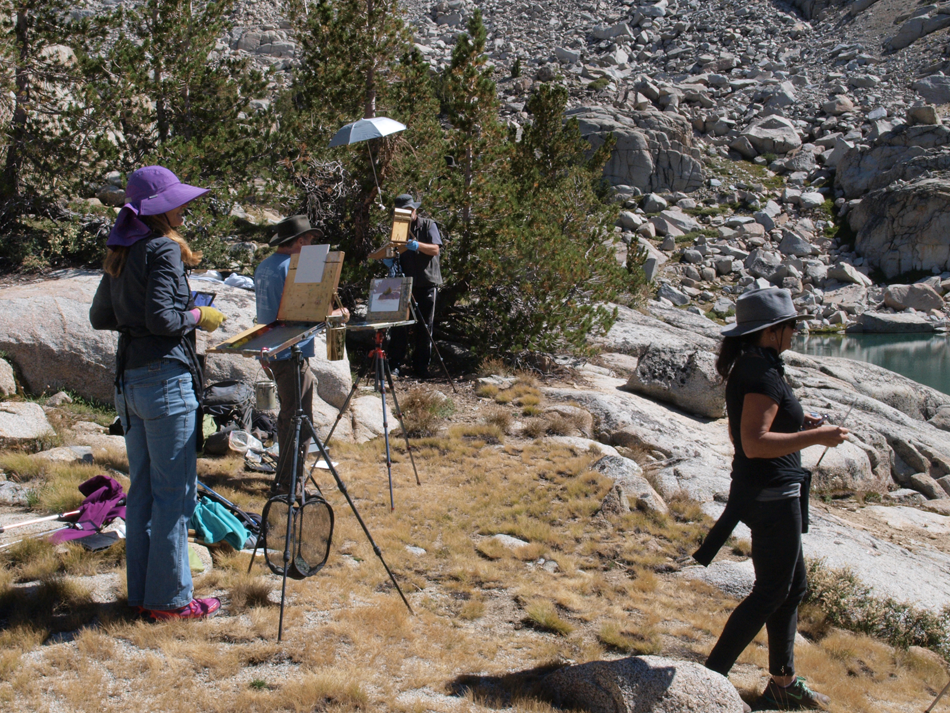
This summer marks the 11th year that Paul Kratter and I have organized a trip into the Sierra back country to paint with other artists for a number of days. The other artists on this trip were Ernesto Nemesio, Suzie Baker, Lori Putnam, Aimee Erickson, and Carol Marine. This year we chose (for the fourth time) Garnet Lake, which sits on the east side of the Sierra crest between Thousand Island Lake, and Lake Ediza. All these drainages form the headwaters of the San Joaquin River, which ends up in California's Central Valley. Surprisingly the headwaters were still running, and the lake, though down a bit, had plenty of water in it, but the only snow in sight was two permanent glaciers on Mt. Ritter and Banner that have been shrinking in size since the first time we saw them in 2006. This was the warmest weather we ever had, and there was also a fair amount of smoke from time to time throughout the week, a reminder of the fires that were burning north of us around Tioga Pass.

One of the interesting features of this location is a basin at the upper west end of the lake that sits right below Mt. Banner, and contains a large shallow melt pond, filled with boulders, surrounded by a large meadow. We first hiked up there in 2006, and though we were able to briefly paint there in 2007 before bad weather drove us out, I have long wanted to get back up there to paint again. This year I was able to get up there for 3 days in a row, in perfect weather. The place has a magical aspect to it.... something to do with the range of color in the water due to depth, as well as how the reflection of the sky can impede, adding another range of blue. Of course the overall location is rather spectacular, plus one gets to share it with other artists. After waiting for 8 years, I was not disappointed in either the aesthetics, or the challenge of painting up there. 


I did paint other views, some of which are shown below, but my primary fascination was hiking up there day after day to try and decode those colors and forms in that incredibly bright light and clear water. Here's a selection of paintings below with notes. 


I worked small this year, primarily 6 x 9, painting 2 paintings per 9 x 12 sheets of paper.
This was an image I did one afternoon, sitting on the ground in front of my tent, looking up the hill. While I painted this, Aimee Erickson started painting me amongst the trees, and Suzie Baker set up and painted Aimee, which is representative of the kind of synergy the entire group had.


The above 2 were painted one after the other, early in the morning on the shore of Garnet Lake before breakfast. As we've done in the past, we have a cook on our trip, and so we are free to work from the time we get up until breakfast. This was the second day in a row I painted these same views, just trying to warm up, and figure out all that was going on. I was especially interested in the soft blue cast shadows of the trees across the shallow water, seamlessly colliding with the reflection of the mountain. More research is needed...

I should mention also that many of us swam in Garnet Lake every afternoon..
It was wonderful. (photo by Carol Marine)

The melt pond at the base of Mt. Banner. Carol Marine, Lori Putnam, and Paul Kratter setting up to paint.

Where artists camp, the laundry looks different.
A few of Aimee Erickson's paintings.


Here's the first piece I did at the pond, after 8 years. The rocks under the water are often a very rich red. At the same time, the deeper the water gets, the bottom surface goes from an ochre to a turquoise. Then the sky reflection starts turning all the shadowed areas navy blue... 

A day or two later, same location, looking at a shallower spot, where you can see how red the rocks are underwater, while the shadows are reflecting the blue of the sky, but the shadow pulls the value way down... 

This image is about 20 feet to the left of the one above. The meadow that surrounds the pond is just an unkempt shag rug of multi-colored grasses, with little inlets from the pond cutting in. The boulder has a toupee of vegetation it.

We were right near the timberline, and there were very few trees above our position. Many of the pines that dwell up there resemble brooms of a sort, in that they are narrower at their base, and wider at the top, in contrast to the pyramidal icons we are familiar with. Above those regions are primarily rocky slopes, giving way to solid rock. This is a view of a ridge to the south, called White Bark Pass, which leads to the Nydiver Lakes and the Ediza drainage. The smoke from the fires added to the apparent atmosphere in views like this. 

Probably the most 'refined' piece I managed to do. This one is 9 x 12, and was painted on the 3rd day of hiking up there to study this stuff. Carol Marine made a very helpful suggestion while I was working: Squint!
Usually I do that to study value relationships, but in this case squinting actually made it clear how strong the sky color was overwriting everything under the water.

Art show! Always a favorite (and humbling) part of the trip to see what everyone else has been doing. Lots of beautiful work. 


----------------------------------------------------------

I should also mention that on our way out, Paul slipped and dislocated his kneecap, leaving him totally immobilized in a matter of seconds. We were about 7 miles from the trailhead, and not on a regularly travelled path. Fortunately one person had a text based satellite phone, and another quickly hiked to a spot where there was cell coverage, so that in short order, 2 emergency calls were made reporting our position and the problem. Unfortunately we had to wait about 3 hours for a helicopter to show up to assess the situation. They circled us for a few minutes, sounded a siren briefly to acknowledge they spotted us, and then flew off. About an hour later they returned, and dropped a first responder named Megan. Following her assessment and guidance, we helped package Paul up, put him on a stretcher, and we all carried him up to the drop zone, where he was essentially zipped up into a giant duffle that the helicopter hauled up and whisked away. It was quite a departure from our usual hike out, and gave us a lot to think about. Everyone pulled together to help in whatever way we could, which was wonderful. In addition, it was evident that technology played a huge role in resolving the situation so rapidly. After the helicopter left, the hike out was quite a lighthearted affair, in late afternoon light, all the way to dusk and moonlight by the time we reached the pack station.

Another memorable trip with great folks. 

Sunday, September 7, 2014

Sierra Painting Pack Trip 2014

A group of 8 artists, Paul Kratter, Terry Miura, Ernesto Nemesio, Michelle De Bragança, Robert Steele, Lori Putnam, and myself, hiked and rode up to (drunken) Sailor Lake in the Sabrina basin in late August. It was a bit of a long grind going up. But, no one was hung over, nor was it raining, so much better than some other years. I am not in great shape though, and the higher elevation of this spot really had an effect. At 11,000', I could only plod very slowly on any incline. If I went any quicker, I simply could not breathe and keep moving. Its pretty humbling. One lesson I learned years ago on these hikes was that I usually could not enjoy much of the view while moving, as I needed to constantly pay attention to where my feet were, to avoid falling on my face, so stopping in order to breathe was a great way to appreciate the scenery as we climbed out of the lake basin. We hiked around towards the back side of Sabrina, roughly level, among many small aspens, and then began to ascend, via switchbacks, and some long, steep inclines over talus slopes, crossing several watercourses along the way. 


The hikers at the Sabrina trailhead. L-R: Lori Putnam, Michelle De Bragança, Ernesto Nemesio, and Terry Miura.

After a few hours of huffing and puffing the point of view begins to change. Those are the Piute Crag  looming behind the Lake Sabrina basin. Less than halfway there, but progress!


About 3 miles in, after surmounting the back wall of the basin, we arrived at Blue Lake, which looked good enough to make us wonder why we needed to go any further, yet we were only half way to our destination. We stopped for lunch and a rest, then continued our upward journey through fox tail pines, amid a landscape dotted with huge erratic boulders, granite benches, walls, and numerous small ponds. We often found ourselves hiking over acres of solid granite, with the trail being marked by stones on either side.

At Blue Lake (actually shot on the hike out). Pretty nice scenery and water here.


The mules had passed us at Blue Lake, so the 5 of us that elected to hike in, were strung out somewhere behind them. I straggled into camp in the late afternoon, met the cook, Ally, and her grandfather, Jerome, who was helping her out. They had a full on cook tent, that looked like a small house, with a metal frame, heavy canvas walls, and a large supply of propane tanks for cooking and heating. I grabbed my gear from the tarp, set up my tent, and started to survey the landscape possibilities.

The view from camp towards Picture Peak. Mt. Haekel on the right, and Clyde Spires over the left shoulder. The cook 'house' to the right of Terry Miura.


 We were camped on the shores of Sailor Lake, which was, in my mind, more of a very shallow, meandering pond, in a descending glacial basin. About a quarter mile 'up' the basin to the west, was Hungry Packer Lake, out of sight over the U shaped ground plane that ended visually in the rocky slopes of Picture Peak, a ragged pyramid that dominated the skyline in that direction. To our left, was a small waterfall, fed from the outlet to Moonlight Lake, which could be reached by a short scramble. A curving wall of cracked granite flanked our north, dotted with small trees, over which some larger crags were visible. If we looked roughly east, down the basin, towards the desert floor, we could see the White Mountains glimmering faintly miles away, while the sloping foreground was a series of ponds, stands of pines, and boulders, which ended in Topsy Turvy Lake. The rest of our horizon was ringed with jagged escarpments and shattered rock slopes, well above the tree line.


A study looking down the basin in morning light. 6 x 9", pastel on paper.

Here's a wider view, looking the same direction, painted on the last morning of the trip.
9 x 9.5", pastel on paper.

Morning Icon worship


Charles Muench, who painted at this spot last year, had advised Paul and I that he felt the scenery was dominated by this singular view of Picture Peak. As a result, I deliberately avoided painting this view all week, though I did paint parts of the mountain.  Others, however, went at the peak every morning from sunrise on. It was very convenient to paint from camp in the morning, as we were served hot coffee at our easels by Jerome. Quite a luxury in such a location. 


North of Morning Coffee, 6 x 9, pastel on paper

The Wall to the West, 9 x 9.5, pastel on paper
Here's an example of painting just a part of Picture Peak, emphasizing atmosphere and scale relationships. Not painting the 'thing' or the object, but elements or aspects that can make for an interesting painting.


The first lake outside of camp that we visited was Moonlight lake, which was a 10 minute scramble to the south. It was big, deep, and unusually turquoise. Ernesto and I painted there one cloudy afternoon, then returned one sunny morning with everyone for a delightful day of painting, and even a little swimming, though it was too cold to stay in very long. 


Sun Spot, 9 x 9.5, pastel on paper
My first painting from Moonlight Lake. The clouds built up pretty quick, but small spots of light would would periodically glow and drift amongst the peaks. This is a view of Clyde Spires, which is visible in the photo above, to the left of Picture Peak. I usually don't do very wide views, and this is a good example of how a small section of a scene will suit me.

A great day at Moonlight Lake. We are often on our own, so it is rare, and fun when everyone is in the mood to paint at the same spot. 

Moonlit Shore, 9 x 9.5, pastel on paper
The south shore of the lake nearest us was full of boulders and cliffs that ran down into the turquoise water. I picked a small section of that to paint. 

Cloud Study, 6 x 9, pastel on paper

We had several consecutive days of cloud build up that threatened a big downpour, yet we never had rain, just masses of cumulus looming over the peaks to the west, then dissipating towards the desert to the east. The edge of this mass would swell and retreat for hours, constantly shifting in form and color.

In the evening the clouds would create enormous variations of light and shadow patterns on the peaks, from ridiculous and unpaintable to sublime 19th century evocations, channeling Bierstadt and his ilk. 

Don't try this at home...

Better.....


We had one day of wind on the trip that just wore us out. It started blowing around 5 am, and did not quit until around 9 that night. Gust were strong enough to demolish one person's tent. I don't know how my cheapo, Big 5 dome tent held up, but it did. Maybe because I piled rocks at all 4 corners to hold down the poles. I still did 2 paintings that day. I put rocks in my tripod bag and hung it from the center post to keep everything from blowing over. No umbrella was possible. I just faced towards the sun, and held a board up with one hand to shade my colors, or huddled near cliffs and trees, to keep the light off my work. People think we are in some kind of paradise up there, but it can be really difficult conditions to work in at times. 


Talus Wind, 6 x 9, pastel on paper
The first painting of the day in strong, gusting wind.

Waterfall, 9 x 9.5, pastel on paper


The wind blew until well after sunset, so we all crammed into the cook's tent on the last night, which was the best thing ever. It was toasty in there. Nothing like suffering all day, then celebrating with good pals near the end of an adventure.


We held a pop up Art show the next morning before we hiked out. It is always a revelation to see the range of work everyone produced. Even when we painted in the same location, we chose different things to paint. Very inspiring. 

-----------------------------------------------------------------------------------------------


 Comparison with the other locations: I do feel that there were scenic elements common to Iceberg, the Nydivers, Ediza, Chickenfoot on the Mt. Morgan side of the lake, and the upper Garnet melt pond area, all within about a 15 minute hike from camp. So, after ten years, there is a lot of familiar territory to be found in a location like this.  That is a big plus. The wind was a negative, but it can be dealt with. 


As a postscript, I must add the following:

We had the worst toilet EVER on this trip. It was so bad it was funny, and was a topic of conversation throughout the week. It was a kid sized toilet seat that was loosely duct taped to a milk crate with a garbage bag stuffed below. This getup was sandwiched between two blue plastic tarps that would blow into you whenever a breeze came up.  A complete ergonomic and hygienic insult in every possible way at every juncture of the process. I finally resorted to seeking other options a discreet distance from camp that were far more functional and comfortable than this setup.

Sunday, June 9, 2013

Pt. Reyes workshop

                               
I taught a 2 day workshop out at Pt. Reyes a few weekends ago. We had sunny skies, but a fair amount of wind, which did have impact our activities, but not our spirit. It was a great group and a wonderful location, which I hope to continue exploring over the seasons and years. As the class convened on a Friday evening at the Clem Miller Center out at Limantour, I drove up in the early afternoon to scout a few spots, and get warmed up.


I drove straight to the beach, and hiked out on the spit about a half mile towards Drake's Estero, realizing eventually that I would never drag everyone out this far unless there was something unique about the view. One justification for it is that the further one walks from the parking lot, the less likely others have painted those views. Disregarding the point of view, the light, color, and forms of the world were not appreciably different, so there was no reason to ask people to walk that far. The wind was blowing pretty strong, so I set up facing into the wind, and painted 2 views from the same spot, exploring the textured masses of foliage and grass, trees making sharp silhouettes into the glare of the afternoon sky, and the cooler colors of distant cliffs in relative contrast to the mid-ground. It was very bright out there, so I tried a coral covered paper, as opposed to my usual default color of twilight. I'm currently of the mind that picking an overall value key, as opposed to merely a "non-conflicting" color like twilight is worth trying, especially when dealing with very bright or dark situations. 2 artists I've seen that use a similar ground are Lorenzo Chavez (pastels) and Jennifer McChristian (Oils). Jennifer's pink ground tends to be a lot more saturated than Lorenzo's.

Just rotating right from the same position, in late afternoon light, looking northwest...
The wind was blowing pretty steady the entire time, and it was getting around 5, so I packed up, hiked back to the car, and drove to the facility, which is located just past the youth hostel at the end of the road. 


Several folks were already pulled up and unpacking, so I did the same. As the days are long, and the light was good, I set up in front of the conference center to do a demo of some trees across the meadow. There were a lot of repeat folks from my previous workshop, so it was a pretty jovial and talkative  group right off. A relaxing way to start a class.


Here's the Friday evening demo, with a fair amount of clean up in the studio.


We got out of camp pretty early on Saturday morning and headed down to Limantour. There was a light haze, most evident when looking towards the sun, so I did my next demo of that, just going for the ragged, graphic silhouettes and the morning glare in the sky. Folks set up all along the path leading to the beach, and for several hours we had very few people come by.

The ever rising wind drove us back to camp around noon. After lunch, everyone put up their work in the conference center, and we had a critique. During that discussion, I was upstaged by a bobcat that was hunting rodents in the meadow behind all the students. One mention of the bobcat, and the critique was abandoned for the next 20 minutes as we watched it twice stalk and pounce, only to come up empty handed.


There was also an abundance of quail, a covey, a plethora... If you left a building they would come running out from beneath it and scurry ahead of you, seemingly in a panic, then suddenly veer out of your path into some shrubbery, like a car unexpectedly driving off a cliff. The specimen below was strutting on a railing outside the window. Yet another distraction from our serious work. 


As it was still windy, everyone spent the rest of the afternoon painting in camp. We had a great feast of a potluck that evening and then called it a day.


Sunday morning, we were back at it, this time painting from the bluff off the parking lot, and looking away from the sun. The flatness of the light was redeemed a bit by some atmosphere, as well as the iconic graphic forms of the estero and the cliffs. A lot of perspective in this sort of view. There were some interesting interpretations of this view, some choosing to focus on the serpentine channels in marsh below us, and others looking way out to the chalky cliffs towards Drakes Estero. I worked on my demo for awhile, then abandoned it to do walkarounds. Most of my demos feel a bit unfinished, and this one was no different, as I leave them alone to go do walkarounds. I did some clean up work on it back in the studio.

We made it back to camp for lunch, a final crit, and then it was time to cleanup and say our goodbyes. I hope to be doing another workshop in the park in October, out at the Lifeboat Station, which is way out by Chimney Rock. I'll post specifics when I know them. Thanks to everyone for taking the class. It was a great group, and for Regina and Grace for providing assistance. Quail and bobcat photos by Janet Theilen, and the group shot is by Grace Bourke, I believe. 


Sunday, April 28, 2013

Warming up

Days are getting longer and the weather is getting warmer around here. Summer is knocking at the door. I painted in the Berkeley Hills on Friday afternoon in front of a film crew from work for an instructional video to tempt people away from their keyboards. This scene must be familiar to anyone who's gone through a body of my work, as I've painted here many times over the last 17 years. In addition, I've dragged probably a hundred colleagues up here to paint with me. Though the shapes are familiar, I always enjoy trying to get the color and light of that specific period. In the afternoon, the sun drops lower and lower, unifying all bg colors and knocking out details, as the glare and haze of the light intensifies. I know the light is always changing, and after 17 years, I've changed as well, so the challenges and pleasures of this sort of scene are renewed. Its always a good workout. Things I contemplate messing with in the studio are the yellow bald spot on the ridge in the upper left, and the edges of the tree silhouettes on top. 

Painted on Saturday down in Canyon, a second growth Redwood and Bay Laurel forest in a ravine, with a trickling creek running through it. I've ridden bikes through there for years, and enjoy coming here to paint, especially when it gets warm out. The temperature in the forest is usually 10 -15° cooler than it is in town. I am intrigued by these types of scenes, and am still trying to get a better handle on controlling them. I tried to stick to a basic pattern of of light and dark, but there's some ambiguous transition areas, and perhaps both tree trunks are too parallel. Overcoming the 'facts' of what lies in front of me in nature is an ongoing challenge. What to leave out, what to modify, avoiding too much detail, figuring out how to 'move the eye', all the while the light is sliding on and off the very objects one is trying to paint. The studio can be an 'ER' of sorts to examine and correct these concerns. This one will need it. 

Sunday mid-morning, back in Canyon, contemplating Redwoods, and their accompanying debris field.
The light glides across twigs, branches, trunks, and leaves at an alarming rate that I'm resigned to. I used my pencil sketch as a map to where the light and shadow patterns were in the foreground, because they were gone in about 20 minutes, sometimes partially returning to taunt me into changing my patterns. We can't keep up. I think there's some amazing things down here to paint, and I'm just trying to decode it right now. Not even sure of the light level yet, as it could be a lot darker, but I get fascinated by the 'shadows within shadows' as I find those patterns to be of interest. Actually, those patterns are shadow masses that are interrupted by twigs and branches, breaking them into a series of mosaic-like shapes. I think of them as shadows trapped in a web of twigs. The trees are a rich, dark, violet red, but a blue green ambient light bathes them from above and around, and sometimes a warm bounce off the ground creates an almost incandescent effect that reminds of me of light in the Grand Canyon. A warm bounce light hitting a warm colored object in shadow is a treat for the eyes. Are any of these ideas clearly expressed in my painting? Merely hinted at. More research is needed!

Sunday, October 7, 2012

Sonoma Plein Air

I had a great time painting this last week up in Sonoma County for  Sonoma Plein Air. I am fortunate to be able to participate in this event, and have done so for 9 out of the 10 years it has been in existence. I have met many artists who have not only  become friends, but provide a great stimulus and camaraderie  throughout the week over impromptu group dinners, discussions about our work and ideas about painting. Being able to see the scope of their weeks efforts on the day of the show is humbling and inspiring. I learn plenty simply by observing what others have chosen to paint, how they handled it,  and for the repeat participants, witness their continued growth from year to year. We all evolve in some way.   I have to also mention the generous hosts and patrons of the community who support this event through volunteer work, providing housing for the artists, and buying the art. It really is a well run event in a beautiful part of the world, all to provide funding for art education in the public schools of the county. Bravo to the organizers and patrons for making this work so well, year after year. 

So that is one way I come out of this week: grateful to be a part of something  that has given me so much back for the effort I put into it. From the 'effort' side of the coin:   Getting up before sunrise on many days, driving around looking for places to paint, trying to stay out of the sweltering heat of Monday and Tuesday, dealing with a foggy morning on another, spending one whole day painting on the coast, and coming away with three 'dogs' to show for it, worrying about having enough pieces for the show, etc. I find it to be  a real challenge to be consistent in the quality of my work, and this week was no exception. Here's a few pieces that made the cut with notes:


Painted on Monday afternoon up in Sugarloaf State Park. I've painted up here before in previous years, often to get out of the morning fog that filled the valley. On this occasion, I headed up there to sit in the shade of the creek that runs through the park to stay cool, as the temperature was around 100°. I did two paintings in the park, this one, and  a failed experiment to paint a view between the trunks of a tree revealing a stomach shaped image of foliage in light and shadow. The creek  was familiar territory. While the dappled light was moving across the creek bottom, the reflection stayed put, so I had some visual structure that wasn't going to run away from me. I've learned  that the smaller the spot of sun light hitting any object, anywhere, the quicker it is likely to move somewhere else. Its primarily a matter of scale that this 'illusion' exists. For example,  if one were painting a shadow cast on the grass of a football stadium from the grandstand, the volume of light area is quite large, and it might take a shadow an hour or more to cover up the region of light. A sun dapple on the other hand may be only a few inches across, and is in constant jeopardy of being obliterated in a matter of minutes due to the rotation of the earth. 


I had exited the park, and was driving out Adobe Canyon Road, when I saw this curve going into the late afternoon sun. I stopped the car and studied it, back-tracked to a parking spot, then hiked back along the road. It was visual stimulus that I couldn't pass up. I had a couple of such accidental encounters during the week, and made me realize that a lot of my planned efforts did not yield results as fresh as the unexpected ones. The light and shadow masses combined with the gradating color hues were the structure of the image. It wasn't about painting individual leaves at all. On the advice of my artist friend, Paul Kratter I chose this piece for the Friday night auction, where it sold and also picked up an honorable mention award for Artist's Choice. 


Another chance encounter that made me stop and paint was this view between two buildings near the plaza in the center of town. I got up before sunrise to paint the dawn light on the hills with the plaza in shadow. While I got some decent color going, my buildings needed a lot of work to be presentable. I'd have to come back another day to finish it. Meanwhile, I was wandering down the block and saw the early morning sun illuminating this little alley space behind a wrought iron gate.


My hosts for the week had a koi pond right outside the cottage I was staying in. I had walked past the pond on the way to my car numerous times and kept imagining I would paint it, but was always headed somewhere else. We had fog on one morning, which kept us from running out to paint, so stayed in, prepping work for framing... trimming, signing, photographing... another part of the process of doing a show like this. Meanwhile the pond was beckoning right outside the window.... paint me! I painted the first one as a gift for my wonderful hosts. After it was done I realized someone might actually buy it, so the next morning I tried another one, which happened to be sunny.


The afternoon light this time of year has a specific warm softness. By soft I mean not as bright. The sun is lower in the sky, so attenuated by more atmosphere which also changes its color. Combine that with the brown hills of fall and there's a specific palette one could see every afternoon, rolling towards the western horizon. The rows of eucalpytus windbreaks along many roads allow these sorts of gap views to work with.


Painted later the same day, doing some half hearted scouting on the way back to the cottage. I ran into another painter at a location I had painted at in past years. We chatted a bit, and I hopped out and plowed into a quick view of the sun blasting through an oak across a field. This fleeting golden light to the right of the oak I consider the province of the artist Christin Coy, who has painted many wonderful views in such light.


One of the many eucalyptus trees planted in windbreaks alongside roads throughout the area. Each one unique in its gesture, colorful bark striations, and unkempt manner. Paul Kratter is quite a master of  painting trees,  and advises designing and pruning if necessary to get them to look presentable in a painting. I think he's right! This painting came together fairly quickly, and I credit Paul's wisdom as part of its success, as I left out several prominent branches and bark debris in favor of a more unified form defined by light and shadow.  One could do a whole series of these. Hmmmm... Something to consider for next year.