Wednesday, July 11, 2012

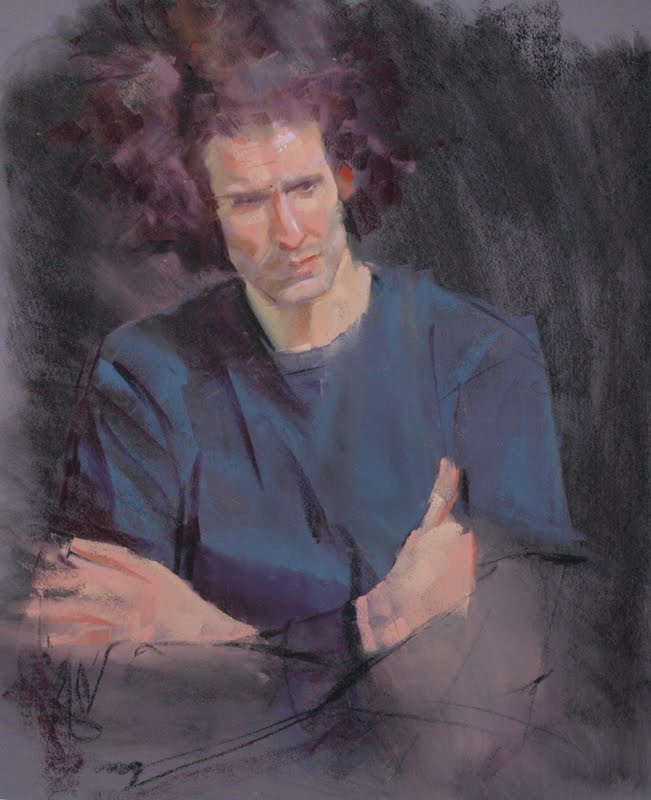
Figure Group


On Tuesday nights I attend a figure group at work. I want to enumerate the ways in which I enjoy this:

1. I get to paint with other artists, and see how they are solving the same problem.
2. We listen to music... I hear new songs, new artists... good work music.
3. The figure is an endless challenge, and I get to practice and explore different techniques in a more stable environment than plein air landscape generally provides.

The image above is roughly an 8 hour pose over 2 sessions. I must thank Maria for pointing out my proportion indiscretions, Rona for her excellent taste in music and miniature painting technique. Paul, Ernesto, Randy and Tom for ongoing visual and philosophical inspiration. And last, but not least, Larissa, the model, for a wonderful pose.

Monday, June 18, 2012

One Day Workshop in Palo Alto

I'll be teaching a one day workshop in Palo Alto on August 4th, sponsored by the Pacific Art League.
We'll be painting at the Baylands, as well as somewhere up in the hills, once I find the best spot to bring a group. Demos, one on one time, as well as some lecture material will make it a busy and fun day. Click here to find out more information and to sign up. Here's a few paintings from this past weekend when I was down there scouting locations, dealing with some of my favorite subjects: reflected light in shadow, atmospheric color, and water. There's plenty to paint in and around Palo Alto!  Hope to see some new faces as well as some familiar ones.


Monday, April 30, 2012

Sprung!

Warm weather, wildflowers blooming, longer days, all signs pointing towards the migratory trend out of the studio, and into the field to tackle the profusion of color and complexity that nature provides in abundance this time of year. Here's three recent pieces in my quest to decode the textures of foliage I often see driving to and from work. I noticed the forget-me-nots about a week ago on the way home in the afternoon light, and made plans to come back and paint. This tiny pale blue flower is rather bleached out by direct sunlight, but pulses a blue radiance in shadowed areas, almost the exact value of the green neighborhood it resides in. There's about a 2 week window where this flower blooms. Hopefully I'll get a few more of these in before they're gone for the year.
This bottom one has a myriad of 'issues', all self-inflicted. There's really more than one painting in here, I readily admit, In addition, though I have a spotty success rate in painting tree roots, I keep trying to sneak them into my work. Did I almost cut the painting in half with that illuminated edge of flowers on the right? Guilty! Plus, that tangled weave of branches in the background tempted me with its persian rug complexity. In short, its a kitchen sink painting, full of too many good intentions. Periodically I fall into this trap, and spring has a beguiling way of deluding me into trying to get it all going in one image. Sometimes I know I'm walking right into it, and still keep going. One can think of images like this as a page full of math calculations, or notes about various painting problems, all tackled with varying success rates in a single image. I find its still worth the effort at times, even if it doesn't gel into an image with a strong, singular impact. There's always next time.

Thursday, April 12, 2012

Gallery Talk tonight in San Francisco


In my last show at the Studio Gallery, my talk was scheduled the same evening as a playoff game between the Giants and some rival team.This time I won't be competing with any sporting events that I'm aware of, and hopefully the weather will curtail its recent outbursts, so there will be some folks willing to make a trip to the gallery this evening at 7.
I've got a range of work in the show of what I might call the usual suspects and terrain, which will be the basis of my talk. I'll try to explain what it is that draws me to paint what I do, and also go into the issue of my evolving studio efforts, and what I can get out of that process that I can't get in nature (and vice versa). I welcome hecklers and those that ask questions, along with the polite listeners. And, of course, as a bonus, all the secrets of Art will be revealed.... Hope to see there!

Monday, April 2, 2012

Upcoming art show (and recent studio work)

My 3rd annual solo show at the Studio Gallery in San Francisco opens this Wednesday. Here are the 7 studio pieces I did for the show. The other 26 paintings were all done onsite at a variety of locations around California.


Rush Hour
Pastel on Canson Paper
16 x 14


Nankoweap
Pastel on Canson Paper
14 x 16
From a raft trip down the Colorado in 2008. I can't tell you how many paintings drifted by while on the raft. Here's two that I couldn't let get away. Nankoweap was actually a view from shore in camp. I have a field study of this one.


Drake's Beach
Pastel on Canson Paper
16 x 20
There are 2 other pieces in the show painted on this day. Ernesto Nemesio and Sharon Calahan and I spent a whole day exploring different areas of the Pt. Reyes locale.

The last 3 are all from last summer's pack trip to the Rock Creek drainage. We camped at Chickenfoot Lake and many of us hiked up to the Gem Lakes area to paint, as the views were spectacular.


Splintered Shore
Pastel on Canson Paper
12 x 16


Gem Outlet
Pastel on Canson Paper
12 x 16


Treasure Beyond
Pastel on Canson Paper
15 x 20

Sunday, March 4, 2012

Edgar Payne Show


Edgar Payne wrote a book called 'Composition of Outdoor Painting' which is considered a classic. I have to confess that I've never been able to read the whole thing, as I find his writing style to be incredibly ponderous and dull. However, the redeeming strength of his book are the numerous thumbnail compositional studies and examples that describe his ideas, analysis, and advice in a very clear and succinct
fashion. To say that Payne practiced what he preached is an understatement. While he may be a less than ideal author for my tastes, his paintings are as strong and clear as his compositional thumbnails, and are full of vigorous brushwork and luminous color. One can learn plenty by studying his originals which are currently on display at the Crocker Museum in Sacramento.


The show features a good selection of his well known subjects, the mountains, the fishing boats, the Southwest, and seascapes, most of them sizable studio efforts. I could only find about 3 pieces that I felt were plein air studies... 2 small seascapes and an alpine scene. What struck me about his work overall is how consistently he adhered to a strong compositional division of tone into 2 major value patterns. If he wanted to further direct the eye, he would push saturation and value more in a specific area, while remaining within the key of that region. His brush scaling was straightforward: the bigger the canvas, the bigger the brush! No more image detail was to be had in the larger paintings, just big, thick strokes of paint. He also seemed to exemplify Charles Hawthorne's oft-repeated advice about ''...putting the right spot of color in the right place", letting edges 'take care of themselves', so to speak. This was especially evident in some of the fishing boat paintings with figures, where there was a lot of blank canvas between brush strokes, yet the image was resolved about a few feet back.

It was clear that the bulk of his imagery was devised in the studio, though based on plenty of firsthand observation from his numerous field trips. He landscaped many of his iconic mountain scenes with lakes conveniently and reliably placed at the bottom of the frame, whether they existed that way in nature or not.
Some of his seascapes contained foam 'serpents' that rivaled a Frank Frazetta painting, all in the service of strengthening the composition

Most of the Southwest paintings had a small grouping of figures on horseback strategically placed to provide contrast of scale to the cliffs and sky.

Payne, a scenic painter and muralist by trade for many years, created a body of work that established an iconic language of landscape in his consistent use of these devices. A critic might dismiss all this as mannerism or formula. Some might call it style. Regardless, he's an excellent painter from whom one can learn and be inspired by. His compositions are rock solid, he captured light and color of various locales and time of day beautifully. Just google image his name and you can read his imagery easily in thumbnail form. There's really nothing obscure or murky about his work. And they are luminous!

In the Flesh

4 hours of an 8 hour pose

8 hour pose

4 hours

12 hours.
I've never spent this long on a single image for my personal work that I can recall. What interests me is that one can keep finding something to paint....or repaint, correct, restate, etc. while trying to keep it fresh. Still after all these hours of labor, I can glance at it as a thumbnail on my desktop and ask myself questions like, why are her arms seemingly so long, her hand so large, what's that rash on her upper chest, why is her right breast lacking form, is her head way too small? Then again, does it matter? This kind of 'work' is more beguiling than I ever imagined. The body is a landscape full of beautiful color shifts, receding planes, valleys, translucency, reflective color in shadow, edges... the list goes on. It is a great, immersive workout. I just dive in and start painting, then repairing, then wandering through different regions conducting experiments on form description and edges... then the pose is over. Time flies by. I don't quite know how to wrap them up yet, or what to leave out. That'll take awhile. Go check out what Terry Miura is doing with the figure if you want to see how strong a reductive approach can be.


Sierra workshop full, Colorado workshop cancelled
For scheduling reasons, I've had to cancel my Colorado workshop. Unfortunately, I could not find an alternative date that worked for this year. My apologies to those that were interested in taking it. Hopefully I can do one another year. My workshop in the Sierra Buttes is full up, with a waiting list.