Monday, April 2, 2012

Upcoming art show (and recent studio work)

My 3rd annual solo show at the Studio Gallery in San Francisco opens this Wednesday. Here are the 7 studio pieces I did for the show. The other 26 paintings were all done onsite at a variety of locations around California.


Rush Hour
Pastel on Canson Paper
16 x 14


Nankoweap
Pastel on Canson Paper
14 x 16
From a raft trip down the Colorado in 2008. I can't tell you how many paintings drifted by while on the raft. Here's two that I couldn't let get away. Nankoweap was actually a view from shore in camp. I have a field study of this one.


Drake's Beach
Pastel on Canson Paper
16 x 20
There are 2 other pieces in the show painted on this day. Ernesto Nemesio and Sharon Calahan and I spent a whole day exploring different areas of the Pt. Reyes locale.

The last 3 are all from last summer's pack trip to the Rock Creek drainage. We camped at Chickenfoot Lake and many of us hiked up to the Gem Lakes area to paint, as the views were spectacular.


Splintered Shore
Pastel on Canson Paper
12 x 16


Gem Outlet
Pastel on Canson Paper
12 x 16


Treasure Beyond
Pastel on Canson Paper
15 x 20

Sunday, March 4, 2012

Edgar Payne Show


Edgar Payne wrote a book called 'Composition of Outdoor Painting' which is considered a classic. I have to confess that I've never been able to read the whole thing, as I find his writing style to be incredibly ponderous and dull. However, the redeeming strength of his book are the numerous thumbnail compositional studies and examples that describe his ideas, analysis, and advice in a very clear and succinct
fashion. To say that Payne practiced what he preached is an understatement. While he may be a less than ideal author for my tastes, his paintings are as strong and clear as his compositional thumbnails, and are full of vigorous brushwork and luminous color. One can learn plenty by studying his originals which are currently on display at the Crocker Museum in Sacramento.


The show features a good selection of his well known subjects, the mountains, the fishing boats, the Southwest, and seascapes, most of them sizable studio efforts. I could only find about 3 pieces that I felt were plein air studies... 2 small seascapes and an alpine scene. What struck me about his work overall is how consistently he adhered to a strong compositional division of tone into 2 major value patterns. If he wanted to further direct the eye, he would push saturation and value more in a specific area, while remaining within the key of that region. His brush scaling was straightforward: the bigger the canvas, the bigger the brush! No more image detail was to be had in the larger paintings, just big, thick strokes of paint. He also seemed to exemplify Charles Hawthorne's oft-repeated advice about ''...putting the right spot of color in the right place", letting edges 'take care of themselves', so to speak. This was especially evident in some of the fishing boat paintings with figures, where there was a lot of blank canvas between brush strokes, yet the image was resolved about a few feet back.

It was clear that the bulk of his imagery was devised in the studio, though based on plenty of firsthand observation from his numerous field trips. He landscaped many of his iconic mountain scenes with lakes conveniently and reliably placed at the bottom of the frame, whether they existed that way in nature or not.
Some of his seascapes contained foam 'serpents' that rivaled a Frank Frazetta painting, all in the service of strengthening the composition

Most of the Southwest paintings had a small grouping of figures on horseback strategically placed to provide contrast of scale to the cliffs and sky.

Payne, a scenic painter and muralist by trade for many years, created a body of work that established an iconic language of landscape in his consistent use of these devices. A critic might dismiss all this as mannerism or formula. Some might call it style. Regardless, he's an excellent painter from whom one can learn and be inspired by. His compositions are rock solid, he captured light and color of various locales and time of day beautifully. Just google image his name and you can read his imagery easily in thumbnail form. There's really nothing obscure or murky about his work. And they are luminous!

In the Flesh

4 hours of an 8 hour pose

8 hour pose

4 hours

12 hours.
I've never spent this long on a single image for my personal work that I can recall. What interests me is that one can keep finding something to paint....or repaint, correct, restate, etc. while trying to keep it fresh. Still after all these hours of labor, I can glance at it as a thumbnail on my desktop and ask myself questions like, why are her arms seemingly so long, her hand so large, what's that rash on her upper chest, why is her right breast lacking form, is her head way too small? Then again, does it matter? This kind of 'work' is more beguiling than I ever imagined. The body is a landscape full of beautiful color shifts, receding planes, valleys, translucency, reflective color in shadow, edges... the list goes on. It is a great, immersive workout. I just dive in and start painting, then repairing, then wandering through different regions conducting experiments on form description and edges... then the pose is over. Time flies by. I don't quite know how to wrap them up yet, or what to leave out. That'll take awhile. Go check out what Terry Miura is doing with the figure if you want to see how strong a reductive approach can be.


Sierra workshop full, Colorado workshop cancelled
For scheduling reasons, I've had to cancel my Colorado workshop. Unfortunately, I could not find an alternative date that worked for this year. My apologies to those that were interested in taking it. Hopefully I can do one another year. My workshop in the Sierra Buttes is full up, with a waiting list.

Sunday, January 22, 2012

Summer Workshop Schedule


I'll be teaching two workshops this summer. Both workshops are open to all levels and will focus on learning to see light and color through hands on work. The first one is a 3 day workshop in Colorado hosted by Terry Ludwig Pastels in Littleton, south of Denver. The dates for that workshop are June 8-10, and the price is $325. We will be exploring the range of views available in this beautiful part of the country from rivers to mountains. There will be a combination of lectures, demos, and one on one instruction. Will we be looking at atmospheric color and light? Yes! Water and boulders will most likely be involved, but we'll deal with the landscape as it comes upon us. I'll be handling the registration and payment for this one so please email me at moraga97@yahoo.com to sign up. I accept payment through check or paypal.


The other workshop is a return to the Sierra Nevada Field Campus on July 15-20 in the Sierra Buttes region on the west side of the Yuba pass. This will be the third season I have taught there, and we are still finding new views to paint among the many lakes and rivers in this area. To sign up and get more information go to the field campus website

Saturday, January 14, 2012

Fun with the Figure


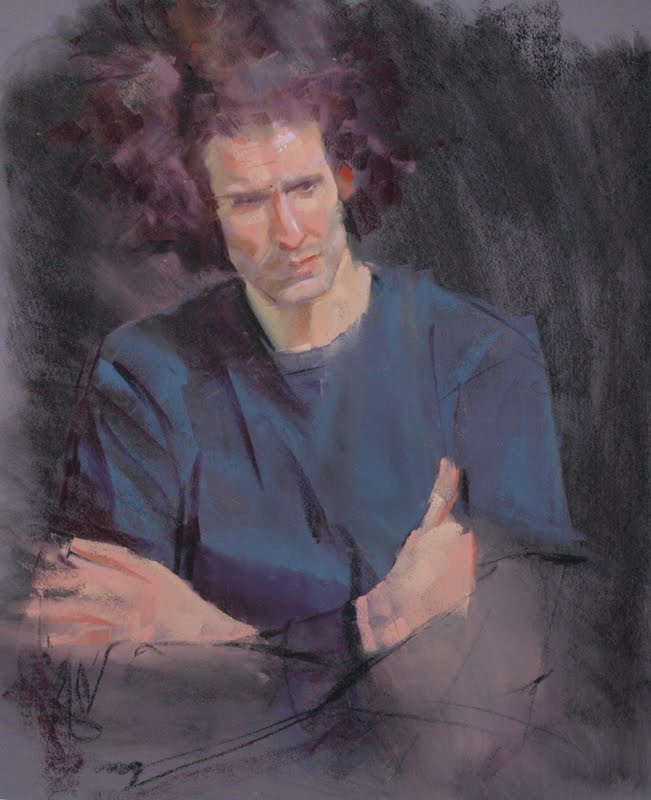
After a long period of ignoring the opportunities and discipline of figure work, I've started attending a weekly long pose group on Tuesday evenings. The pose is 3 hours. I forget how much fun it is to work with others in a studio environment. In some ways it is much more contemplative than working outdoors. Music is playing, the lighting is stable, you can see how others are handling the pose, which can be inspiring and instructive. The figure presents a wonderful set of challenges to explore... edges, temperature, subtle value shifts, clothing patterns, hair... really a laundry list of things to observe and use as a 'recipe' of sorts in your own work. I'm also learning how much my drawing needed this. I am really out of practice on proportion, and end up re-working a fair amount to get various body parts to all fit together. When I'm painting a tree or shrub, you can move a lot of elements around to suit the composition, but it doesn't work that way with the figure, at least for me. I dive in, then I find around the end of the second pose, I'm doing a lot of repair work.


This is one week of a 2 week pose. It was actually a 3 week pose, but I started over the second week to make the figure larger by cropping in, so I could get a better chance to work on the head with my chunky pastels. This is where I miss the paint brushes, but I'm still having fun. Both pieces are on Canson paper around 18 x 24.

Sunday, December 25, 2011

Christmas Day

Its been a sunny and dry holiday season in this neck of the woods, though there was ice on the deck this morning. I feel like I'm hibernating... sleeping in late, eating some wonderful meals, and enjoying time with family. It is good to be home for a few days with everyone around. I had a few hours free today before heading over to my folks for dinner, so went through our back gate onto the hill behind our house. I came across the rear hindquarters of a deer, primarily bones and a bit of fur near the hooves. Coyotes? A lone turkey lurked furtively among the small oaks, keeping me in view as I wandered about. There was quite a bit of haze in the air today and I was attracted to the blown out light pouring over the crest of the trees on the hill, the polka dot sky holes, with minimal detail forming a back drop for the foreground foliage patterns. Highlights on branches, some backlighting, and the range of color and value between light and shadow were the basic ingredients to work with. The sun, though quite close to the trees, just slid to the right instead of dropping down behind them as I worked, so the foreground shrub and sapling stayed in relatively the same light for about 90 minutes. For the past few months I've been painting in and around a redwood forest not far from where I live, and have been working in the shade. My hands and feet get pretty cold after an hour or so. It was nice to get out and work in direct sunlight on one of the shortest days of the year.

Friday, September 2, 2011

Sierra Pack Trip


This year marks our 7th annual painting packtrip into the Sierra back country. We were a group of ten this year, nine painters and one photographer:
Terry Miura
Daniel Aldana
Paul Kratter
Sharon Calahan
Ernesto Nemesio
Timon Sloane
Michele deBraganca
Jim Wodark
Bob Watters
Terry, Timon, and Sharon have already posted reports about the trip, so check out everyone's sites to see their work and impressions. We reprised our destination from last year to Chickenfoot Lake at the southern end of the Little Lakes Valley, a glacially carved groove about 4 miles long, surrounded by high ridges and peaks on 3 sides. The trailhead starts at 10,000 ft. and climbs another 500 over 3 miles to our campsite. As we have done in the past, mules carry the bulk of our gear, and we have a cook in camp to prepare our meals, so the focus of our labors is on painting, hiking, sleeping, and... eating! Next year, its oatmeal for me at breakfast, is all I can say about that. The pack station is Rock Creek, and our excellent cook was Gene.

We hiked in on a Monday morning, and were at the campsite probably around 10:30 a.m. As the mules hadn't yet arrived, we took a hike up to Gem Lakes to sight-see. I found a new shortcut to the lakes from last year, and was able to explore the lower lakes carefully, running into a family camped on one of them. We talked for awhile, then I moved on. I met up with some of the group and we decided on the spur of the moment to hike over a high ridge to the Treasure Lakes basin, probably a mile or so aways. We traversed granite benches, and scrambled up a few areas before coming out on top of the ridge. We explored the three lakes for awhile, then hiked down the outlet, which was a lot of boulder hopping and squeezing between rock walls and willow shrubs... not a fun descent. On the way down we observed an avalanche chute that had a mass of trees piled up at the bottom. Trees still standing further up the slope only had their tops broken off, as they must have been partially buried/protected by the snow.

When we got back to camp, it was fairly late, but I had still had enough energy before dinner to wander around near camp and find an alignment of a foreground boulder and a snow glazed peak to explore.


The next morning, I hiked up to the lower Gem lakes via my shortcut, and painted near the family that was camping. They periodically would come by to assess my progress, and we would chat a bit. Other artists were within sight and earshot as well.
I did one view of the shoreline near my feet, enjoying the color range of wet and dry surfaces, as well as the added colors in the reflection of water from sky and trees.


After taking a break and eating lunch, I painted a view across the lake of part of the rocky shoreline that had a pink and pale green color, with oddly irregular sediment 'ribbons' passing through it. This may be one of those things that end up perplexing a viewer too much. It was perplexing enough to paint, but there you have it.


Wednesday already! I slept in a bit, then hung around camp, rinsed off in the frigid waters of Chickenfoot, and took a solar shower afterwords. Then I painted this view of a rocky inlet from a spot very close to my tent. I took my time, concentrating on edges, and even used one of my umbrella extensions as a maul stick, as suggested by Pat Kellner, of Best Brella. I hiked up towards Gem in the late afternoon, and tried painting a ridge to the west that resembled a pipe organ, but it didn't separate very well from the foreground. Ah well.


Thursday. Here's a typical morning study, looking a fg and bg temperature and value relationships that are specific to that time of day. Also thinking about the spill of color around fg edges that seem to occur in certain situations. The boulder is a bit silly, being practically a cube, but I went with it.


Back to Gem Lakes for another slice of shoreline that caught my eye. On this trip I tried using another color of Canson called 'moonstone'. Lorenzo Chavez makes use of it, and I wanted to give it a shot on a high keyed image like this.


I hiked over to the upper lake, where this wall was slowly going into shadow in the late afternoon, giving me an interesting foreground in a separate value range than the delicate snow patterns on the peak behind it. This was the ridge we climbed over to get to the Treasure Lakes basin on the first day of our trip.


Friday. Clouds were coming over the southern peaks early in the day. I was hiking towards Gem again, and took a slight detour towards Morgan Pass, to examine a small drainage off the trail. It ran through one of those steep meadows that John Muir has described so well, the meadow and the water both disappearing into the talus below Mt. Morgan. I explored it for awhile, and then started climbing back towards the trail, where I came upon a set of Bristlecone Pines with the peaks behind it periodically going in and out shadow. Plenty to work on, so I settled in. After about an hour or so, the clouds had built up pretty solidly, and I heard the first rumble of thunder. As I was about a mile from camp, and had neglected to bring my rain jacket, I decided to get out of there. Hiking down the trail, groups of backpackers were pulled off to the side, gearing up, and covering their packs in garbage bags. Rain began to fall in big drops, but never really poured. By the time I got near camp, the sun was out... but only briefly. Gene, our intrepid cook was putting up a big tarp to give us a dry dining area. I stashed my gear in my tent and went to help him. As we worked it got cloudy, then hail came pouring down for a few minutes, followed by sun again. Classic high mountain weather. Most of us appeared in camp in the next half hour or so, except Ernesto, who had hiked up to Treasure Lakes to paint all day. Out came the wine and the chess board, and we took it easy for a few hours, watching the clouds pass over.


It remained sunny long enough at times that 3 of us were suckered into setting up our gear. Within minutes rain began to fall.
We put up our umbrellas, and I retreated under the tarp for further protection, though I was still getting raindrops on my work.


Saturday. Painted right near the trailhead parking lot after hiking out. This is Rock Creek tumbling downhill, with a willow shrub perched in the stream, holding on. It was another great trip, with good folks, tasty food, and beautiful scenery.